ADS

Showing posts with label pesto. Show all posts

Asparagus Pesto with Herb Pasta

Lately, I’ve been thinking about how much the local food scene in Austin has changed over the years. Many years ago, I visited the lone, quiet, little farmers’ market on Wednesdays in the parking lot of the old Whole Foods. That was way before Whole Foods moved into the current flagship location with the corporate headquarters upstairs. It was just a handful of us who showed up for the market which consisted of a few vendors who brought a couple of carrots and maybe a turnip or two. I’m exaggerating, of course, but there wasn’t nearly the array of produce, eggs, meat, seafood, prepared foods, and artisan-made products you can find at our markets today. And, these days, we have farmers’ markets in several parts of town happening almost every day of the week. It wasn’t even that long ago, three years perhaps, when getting locally-grown asparagus was difficult. I remember the first vendor who offered asparagus and how precious and limited the supply was. When I heard it was available, I rushed to the market early one Saturday morning and nabbed one of the few, skinny bunches. This year, I’ve seen multiple vendors with beautiful asparagus. More artichokes are showing up lately as well, and I’m thrilled to hear we’ll be receiving some from our CSA next week. It’s exciting to watch our local food options continue to expand. Last month, I brought home lots of asparagus from Hairston Creek Farm. It was so fresh and tender and completely unlike what’s available at the grocery store. I sauteed chopped pieces of it in butter and poured whisked eggs over the top to scramble with it. I also tossed some chopped asparagus into a Thai curry soup just to warm it through before serving. And, I made my favorite asparagus dish of all time. I’ve been making this asparagus pesto for years during the season, and I never thought to mention it here. It’s incredibly simple, and the texture of the pesto is silky smooth. I usually use dried pasta, but this time I went all out and made fresh pasta with chopped herbs incorporated into the dough. It was a celebration of spring on a plate. 

The pesto is found in On Top of Spaghetti which is one of my most favorite books for pasta. You simply roast one pound of trimmed asparagus spears at high heat, like 500 degree F, for a few minutes until tender. Roasting time will depend on the size of the spears. Just toss the spears with a little olive oil and season with salt and pepper before roasting. Once the roasted asparagus has cooled a bit, roughly chop it and use a spatula to transfer the asparagus pieces and any oil from the pan to a blender. Add two-thirds cup of extra virgin olive oil, and I know that sounds like a lot, and puree until completely smooth. Taste and add more salt if needed. That’s the asparagus pesto. It can be made in advance and stored in the refrigerator. Just bring it to room temperature or heat it in a saucepan over low heat before adding to cooked pasta. For the pasta, I followed another favorite recipe which is found in Stir: Mixing It Up in the Italian Tradition. Two cups of flour are mixed with two whole eggs plus four egg yolks and a teaspoon of salt. I mix the dough in a bowl, and then knead by hand for a few minutes before wrapping the dough in plastic and letting it rest for 30 minutes. This time, I also added chopped herbs from my garden which flecked the dough with green. Speaking of color, my pasta dough was especially yellow this time thanks to gorgeous eggs from Milagro Farm. The yolks were beautifully orange. I divide the pasta dough into four pieces for rolling through the machine, and I cut the rolled sheets into thin spaghetti for this dish. I left the pasta to dry at room temperature for half an hour, and then covered it to store in the refrigerator until I was ready to cook. A big pot of salted water was brought to a boil, the fresh pasta was cooked for two minutes or so, and some pasta water was saved before draining. Since I was enjoying our local asparagus so much this year, I bought extra and quickly cooked some chopped pieces to add to the pasta as it was tossed with pesto. I added a little pasta water to thin the pesto slightly. In On Top of Spaghetti, Pecorino is suggested for serving with this dish, but I always use Parmigiano Reggiano instead. 

I have a lot of favorites when it comes to food, but this is in that special category of favorites. Getting to make this pesto with locally grown asparagus and the fresh pasta with incredible, local eggs and home-grown herbs made it better than ever. It’s a continuing pleasure to watch our local food scene grow and to discover new things each time I visit our markets. 

I am a member of the Amazon Affiliate Program.

Roast Zucchini Salsa

Roast Zucchini Salsa

Not too long ago a made an absolutely fabulous swiss chard pesto that was really more of a combination of a pesto and a salsa, and I have been fascinated by the idea ever since. With all of the zucchini around these days I was thinking that a zucchini salsa/pesto would be a great way to enjoy some! At its base this zucchini salsa looks like a basic pesto with the basil being replaced by zucchini, the pine nuts replaced with pepitas and the lemon juice replaced with lime juice. From there some more salsa like ingredients are added including some spicy jalapeno peppers and fresh cilantro. Of course I decided to roast the zucchini first to tenderize it and bring out more of its flavour! Because of the roasting, this salsa takes a bit of time to make but well worth it! The roasted zucchini goes amazingly well with all of the flavours in this salsa and the creaminess of the pureed pepitas adds a whole new dimension of texture.

Read the recipe »

Swiss Chard Salsa

Swiss Chard Salsa

Swiss chard is a green leaf vegetable that I enjoy but I feel that I do not use it nearly often enough so when I came across the idea of a swiss chard pesto on Bev Cooks, I was immediately intrigued and knew that I would have to try it. This pesto/salsa is pretty simple with a base of fresh swiss chard which is pureed with some garlic, jalapenos and pepitas (otherwise known as toasted hulled pumpkin seeds). I was thinking that this pesto is really more like a cross between a pesto and a salsa with its use jalapenos and I took that idea and ran with it a bit adding lime juice and plenty of cilantro. I have to say that this swill chard pesto/salsa is one of the best pestos that I have ever had and I found myself having to resist eating the whole batch by the spoonful before I got to use them in some tacos!

Read the recipe »

Steamed Clams and Basil Pesto

I don't eat red meat for several reasons including environmental ones, but I do eat seafood. I always try to make good, environmentally-sound and healthy decisions about which seafood to choose. It's not always easy, and the news about which type of fish is a sustainable choice seems to change daily. So, I was thrilled to see this new book from Washington, D.C. chef Barton Seaver, For Cod and Country: Simple, Delicious, Sustainable Cooking, and I received a review copy. It acts as a guide to all the issues surrounding how to choose fish, and then it provides great ideas for turning those fish into meals. Seaver explains that the best way to work towards restoration of marine ecosystems is to support the fisheries that are working responsibly and enjoy the best choices we have with lots of seasonal vegetables. And, the book assists with just that. You won't find recipes for overfished species like bluefin and yellowfin tuna, but there are several ideas for other, sustainably caught species of fish. Since some fish are seasonal, the book is organized in sections from spring to winter with side dishes and sauces made from vegetables and herbs available at each time of year. There's also an additional section for all the types of seafood that are available year round. So far, I've tried the mussels with IPA and roasted garlic and the grilled okra with charred onion dip. Both were simple dishes with big flavors. Others I look forward to trying are warm poached salmon in red wine sauce, smoked sardines with mixed greens and fig-olive dressing, pumpkin and pear panzanella with pumpkin-seed vinaigrette, and the smoked salmon and goat cheese sandwich to name a few.

Since clams, as well as mussels and oysters, are a sustainably farmed option and are always available, and since my basil plants are still going strong, I couldn't wait to try the clams with basil pesto dish. Seaver prefers the sweetness in walnuts to the flavor of pine nuts for his basil pesto. So, walnuts were toasted, and then they were tossed in a colander to remove some of the skins. Another difference with this pesto was the choice of mostly canola oil with just a little added extra virgin olive oil. The two oils and some garlic were placed in a blender and pureed, and then basil leaves and walnuts were added and blended until smooth. Then, littleneck clams were steamed in white wine. When open, the clams were transferred to a serving bowl, the cooking broth was poured into a mixing bowl while leaving any sand in the pot, and the basil pesto and some butter were stirred into the broth to form a sauce. The sauce was poured over the clams, and toasted bread was served on the side. The flavors were bright and fresh, and we used the bread to capture every bit of the sauce.

The book includes plenty of information about understanding fishing methods and how to choose fish wisely and substitute better choices for those that are overfished. But mostly, Seaver's enthusiasm for sustainable seafood, healthy portion sizes, avoiding toxins in seafood, pairing seafood with seasonal vegetables, and just plain, old, delicious cooking, make this book all about truly enjoying the best of seafood.

See my review of For Cod and Country: Simple, Delicious, Sustainable Cooking and get this clams with basil pesto recipe at Project Foodie.


Grilled Vegetable and Tofu Lasagna with Pesto

This dish is as easy-going as summertime itself. Zucchini, yellow squash, and slabs of tofu are briefly grilled and then tossed in a lemon marinade. They can be used right away while still warm, or as they did in my case, they can sit in the refrigerator overnight until they're layered into this lasagna-like construction. The lasagna itself can be served warm, room temperature, or chilled. You can skip the grilled tofu and use slices of fresh mozzarella instead. Or, as I did, you can serve burrata on the side. The fussiest element of this dish is probably the pesto, but that's a treat for me to make because my basil plants are growing strong despite our unstoppable heat. Then, there are the tomatoes which only have to be cut into thick slices, and they're ready to go. This dish has a completely no worries kind of attitude. You can't go wrong with it. The recipe is from the March gardening issue of Living magazine, and I held onto it until big, red, heirloom tomatoes were here and locally grown zucchini and dark, yellow squash were at the peak of their season.

The zucchini and squash were cut into long, thin slices, and the tofu was pressed to remove water and cut into thick slabs. Everything was brushed with olive oil and seasoned with salt and pepper and grilled for a few minutes per side. After grilling, the vegetables and tofu were placed in a lemon marinade. To make the marinade, olive oil was heated with lemon zest and garlic, and then lemon juice was added. I left the vegetables and tofu covered in marinade in a container in the refrigerator overnight. Next, basil pesto was made the usual way. Toasted pine nuts and garlic were pureed in the food processor, basil leaves were added, olive oil was drizzled in while the motor was running, and it was seasoned with salt and pepper. Then, the lasagna was assembled. The tofu was cut into thinner slices before stacking with the zucchini and squash. Tomato slices and whole basil leaves were included in the layers, and the pesto was dribbled here and there while building. Once completed, the lasagna could go have gone back into the refrigerator, but I served it at room temperature. Surprisingly and pleasantly, it was easy to cut and the layers stayed in place as portions were transferred to plates.

A little smoky flavor from the grill was welcome among the summer vegetables and tofu, and the ripe tomatoes and basil pesto were a fitting sauce. For a bunch of simple, laid-back ingredients, they all came together into a substantial, flavorful, finished meal.


Greek Style Roasted Red Pepper Pesto

Greek Style Roasted Red Pepper Pesto

One of the things that I really like about pestos is that they are fun and easy to play around with. Despite the fact that they do not have all that many ingredients in them, changing just one or two can completely change the flavour profile of the pesto. The other day when I was going through my freezer I came across a cache of roasted red peppers that I had frozen back in the fall and I remembered an experiment that I had wanted to try with a roasted red pepper pesto. I don't tend to use fresh oregano all that often and I had been thinking about new ways to use it when the idea of replacing the basil in a roasted red pepper pesto with some would be particularly nice. Oregano definitely reminds me of Greek cuisine and that got me thinking about other Greek flavours when I thought that some salty feta might help balance out the sweetness of the roasted red peppers and balsamic vinegar. I have to say that I quite enjoyed this use of the fresh oregano in the roasted red pepper pesto! You can use this pesto as a sauce for a pasta or as a condiment and it works rather well as a spread in sandwiches.

Greek Style Roasted Red Pepper Pesto

(makes 1/2 cup)
Printable Recipe

Ingredients:
2 large roasted red peppers
1 tablespoons fresh oregano (optional)
2 cloves garlic (chopped)
2 tablespoons pine nuts (toasted)
2 tablespoons feta (crumbled)
2 tablespoons olive oil
2 teaspoons balsamic vinegar
salt and pepper to taste

Directions:
1. Place everything into a food processor and puree.

Use in:
Roasted Red Pepper Pesto Pasta with Kalamata Olives and Feta

Similar Recipes:
Roasted Red Pepper Pesto
Sun Dried Tomato Pesto
Htipiti (Greek Roasted Red Pepper and Feta Cheese Dip)
Greek Roasted Red Pepper Pesto Pasta with Feta and Kalamata Olives

Garlic Oil Poached Shrimp with Sun Dried Tomato Pesto

It's no secret that some of my favorite food is of the Italian variety, so when I was offered some products to sample from Nudo I happily accepted. Nudo has been in business since 2005 when the owners finished restoring an abandoned olive grove in Italy's Le Marche region. They produce small scale olive oil with traditional farming methods, and you can adopt an olive tree for a year which allows you to receive all the olive oil produced from it during that year. Nudo's extra virgin olive oils and flavored oils are combined with vinegar, pesto, pasta, and more in a range of gift baskets. My samples included both garlic and basil flavored oils, organic sun dried tomatoes, and organic basil pesto. The oils are packaged in tins which prevent light from affecting the oil, and the options they offer are extra virgin first cold press, organic extra virgin, lemon, mandarin, chili, garlic, and basil. My first idea for tasting the samples was to toast some crostini and top them with goat cheese, sun dried tomatoes, and a dollop of pesto. The mix of chewy, intense tomatoes and basil-scented pesto was great with creamy goat cheese, but I wanted to put the products to another test before mentioning them here. I decided to poach some shrimp in the garlic oil and make a pesto with the sun dried tomatoes. The two would have been fine on their own with the pesto used as a dipping sauce for the shrimp, but I tossed the pesto with some fresh pasta and topped it with the shrimp instead.

For the pesto, I emptied the jar of oil-packed sun dried tomatoes into the food processor and added some chopped garlic, a handful of pine nuts, and a some of the basil oil. That was whizzed into a state of pestoness and set aside. To oil poach shrimp, I used a small saucepan and enough garlic oil to mostly cover ten or twelve large shrimp. The oil was heated just to about 170 degrees F. The oil should just gently cook the shrimp rather than deep fry them. Keeping the oil around 170 will allow the shrimp to absorb the flavor while cooking over the course of about seven minutes. I had some fresh pasta in my freezer, so I cut it into wide ribbons, boiled it, and tossed it with the sun dried tomato pesto. The garlic oil poached shrimp sat on top.

The garlic oil is more subtle in flavor than you might think. It flavored the shrimp just enough while poaching. I also found the garlic oil when used in a vinaigrette for salad left it with just enough garlic flavor and not too much. The plump, sun dried tomatoes made a nice pesto too. These are flavors that are meant to be together, garlic, olive oil, sun dried tomatoes, and when the quality of each thing is as good as it was here, you can't go wrong.

Gnocchi with Pesto

There are some things that I am completely afraid to attempt to cook, but as of last week, there is one less of those things. Since forever, I was terrified of gnocchi, and it had nothing to do with the process of making the dough and cutting the pieces. I was afraid of the result. I remember an episode of Top Chef in which someone, and now I can’t remember who it was, made gnocchi. One of the judges, can’t remember which judge either, held one little dumpling on a fork above his plate and let it drop. It thudded to the plate like a heavy ball of paste. That’s what frightened me. If I was going to cook potatoes, rice them, make dough, cut it into little pieces, boil them, and make some kind of sauce for them, I wanted them to be light and pillowy and delicious. So, for my first foray into gnocchidom, I gathered several sources of information and learned that every cook seems to have a different opinion about what makes perfect gnocchi. Marcella, in Essentials of Classic Italian Cooking, recommends boiling potatoes, and she boils them, skins them, and purees them in a food mill. Mario, in Malto Italiano, uses russet potatoes instead, but he also boils them, skins them, and purees them in a food mill. Anne Burrell, who calls her recipe "Light as a Cloud Gnocchi," uses russet potatoes, bakes them, skins them, and purees them in a food mill. Last, I had the good fortune to watch David Bull make gnocchi right in front of me at a Central Market cooking class that I attended earlier this summer, and his potato choice and cooking method were the same as Anne Burrell’s. So, three of them used russet potatoes, and it was split two to two for boiling vs baking. I nervously looked from one recipe to the next, comparing notes, biting my nails, and finally jumped in and made my first batch of gnocchi.

It killed me a little to ignore Marcella’s advice, but russet potatoes seemed like the fluffier choice, so that’s what I used. And, again, since baking seems to produce a fluffier cooked potato than boiling, I ignored Marcella and Mario and baked rather than boiled. I don’t own a food mill, so I used a ricer to smoosh the cooked potatoes. Then there are the eggs, if you’re adding eggs that is. Marcella recommends that you don’t, but everyone else was for eggs. Marcella explains that gnocchi from the Veneto are cloud-light and are made with no eggs. She goes on to say that gnocchi dough with eggs is easier to handle but can easily become rubbery. For my first time with this, I felt like I needed eggs if this was going to become a dough, so to the four big, riced potatoes, I added two eggs. David Bull used semolina flour while everyone else added all-purpose flour. I used all-purpose. You should start with half the suggested flour and work in the rest as needed. Two other last ingredients were parmigiano which Anne Burell added and I didn't and chopped chives which David Bull added to his dough and so did I. Everyone says to knead the dough gently and don’t over mix it. Anne Burrell leaves all the ingredients on a board and folds in the eggs and flour with a bench scraper. That seemed like a good idea, so I did that. Last, when you have a cohesive dough, you break off pieces, roll them into ropes, and cut the ropes into gnocchi. You can leave them like that or roll them on the back of a fork or along a cute gnocchi board to make grooves in them. You press with your finger as you roll so each piece has a dent one side and ridges on the other. I have to explain that I bought the cute gnocchi board months ago as a way of convincing myself to make gnocchi. It worked eventually. Once you have your finished gnocchi, you can cook them immediately or freeze them. I left mine in the refrigerator for a couple of hours before boiling, draining, and adding sauce.

For the sauce, I went back to Marcella and followed her instructions precisely for basil pesto. It’s pretty much what you would expect for pesto except that she adds three tablespoons of softened butter after she stirs in the cheese. It was a lovely pesto. She recommends it as one of the best sauces for potato gnocchi, and I’m a believer now too. In an attempt at balancing the meal, I sauteed some sliced summer squash and mixed that with the boiled gnocchi before topping it all with pesto. After all of that, was there a thud when a piece was dropped onto a plate? No, believe it or not, they were truly tender and delicate although not quite perfectly formed. I actually wondered if I didn’t knead the dough quite enough. I’ll work on that next time, since there will definitely be a next time, and I might even try boiling the potatoes and not adding eggs.


Basil Pesto

Basil Pesto

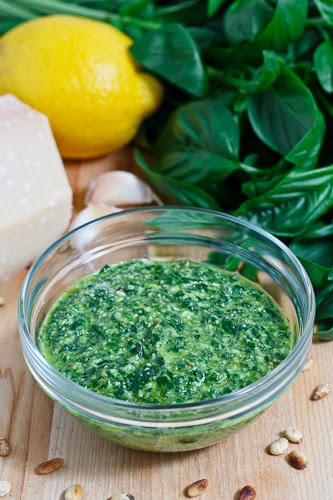
One of my favourite things about the summer is all of the fresh basil and one of my favourite things to do with the basil is to make basil pesto. Basil pesto is as easy to make and pureeing everything in a food processor and it captures the essence of summer perfectly. The easiest way to enjoy basil pesto is on pasta but you can also use it as a condiment and it adds a ton of summery fresh flavour to whatever you add it to and I particularly like adding it to sandwiches. Another great thing about basil pesto is that it freezes well so you can save some of summers essence for later. If you plan on freezing it omit the parmigiano-reggiano and add it when you thaw it out.

Basil Pesto

(makes 1 cup)
Printable Recipe

Ingredients:
1 cup basil (packed)
1 clove garlic
2 tablespoons pine nuts (toasted)
1/4 cup parmigiano-reggiano (grated)
3 tablespoons olive oil
lemon juice to taste (optional)
salt and pepper to taste

Directions:
1. Place everything into a food processor and blend.

Use in:
Caprese Chicken Pesto Pasta
Parmesan Crusted Pesto Tilapia Bruschetta
Bruschetta Chicken Pesto Tart
Diced Caprese Salad
Creamy Pea and Artichoke Pesto Pasta Salad
Grilled Portobello and Roasted Red Pepper Sandwich with Pesto
Diced Caprese Salad with a Pesto Dressing
Caprese Sandwich
Asparagus and Zucchini Farro Salad
Tilapia with Pesto and Roasted Tomatoes
Slow Roasted Tomato BLT
Caprese Grilled Cheese Sandwich
Tomato and Basil Pesto Parmesan Tart
Asparagus, Baby Artichoke, Pesto and Goat Cheese Quiche with Quinoa Crust
Pesto Guacamole
Pesto Zucchini Fritters with Caprese Bruschetta Topping
Creamy Parmesan Tomato and Spinach Tortellini Soup
Pesto Zucchini and Corn Quinoa Salad

Similar Recipes:
Sun Dried Tomato Pesto
Roasted Red Pepper Pesto
Pistachio Asparagus Pesto Pasta
Spinach Pesto (aka Spanakopita Pesto)
Swiss Chard Pesto
Roast Zucchini Salsa
Grilled Eggplant and Roasted Red Pepper Sandwich with Halloumi
Pesto Grilled Shrimp Caprese Quesadillas

Zucchini and Sun Dried Tomato Pesto Parmesan Tart

Zucchini and Sun Dried Tomato Pesto Parmesan Tart

A little over a year ago I made the asparagus and gruyere tart for the first time and I was immediately hooked not only to that particular tart but the whole style of tarts. These simple premade pastry tarts are so easy to make and they always taste great! You pretty much just roll out some puff pastry or oil up a few sheets of phyllo dough and then top it off rather like a pizza with sauces, cheeses and vegetables. Despite the fact that the topping options are near endless I have been enjoying highlighting a single in season vegetable like asparagus, tomatoes or zucchini. One of my favorites so far has been a zucchini and feta ricotta tart so when I came across a zucchini and sun dried tomato pesto parmesan tart on Cook Sister it made it to my meal plan as soon as the local zucchini was in!

In my opinion, you really can't go wrong with a flavour packed sun dried tomato pesto so I already knew that this tart was going to be a winner. Knowing that the sun dried tomato pesto was going to be key to this dish I set about making my own and homemade pesto is actually rather easy. Although you could mash everything up in a mortar and pestle as is traditional, it is much easier to just throw the ingredients into a food processor and puree them. One of the things that I like so much about making you own pesto is that you can experiment and change up the flavours each time by using different nuts, cheeses or even adding new things like say a splash of balsamic vinegar. With tomato season just around the corner you could even make you own oven dried tomatoes for use in this pesto.

Zucchini and Sun Dried Tomato Pesto Parmesan Tart

Zucchini and Sun Dried Tomato Pesto Parmesan Tart

(makes 4 servings)
Printable Recipe

Ingredients:
1 sheet puff pastry (thawed according to the packages directions)
1/2 cup sundried tomato pesto
1/2 cup parmigiano regginao (grated)
1 handful basil (torn)
1 large zucchini (thinly sliced)
salt and pepper to taste
1 tablespoon olive oil

Directions:
1. Roll the puff pastry out to a 16x10 inch rectangle.
2. Score a line around the puff pastry 1/2 inch from the edge.
3. Spread the pesto over the center of the dough and top with the parmigiano reggiano and basil.
4. Arrange the zucchini slices in a single layer on top of the pesto and season with salt and pepper.
5. Brush the outside inch of the pastry with the oil.
6. Bake in a preheated 400F oven until the zucchini is tender and the pastry is golden brown, about 15-25 minutes.

Similar Recipes:
Tomato and Basil Pesto Parmesan Tart
Zucchini and Feta Ricotta Tart
Tomato Phyllo Tart
Mushroom and Caramelized Onion Tart
Asparagus and Gruyere Tart
Fiddlehead Tart

Sun Dried Tomato Pesto

Sun Dried Tomato Pesto

Pestos are really easy to make and I always enjoy playing around with different flavours. One of my favorite pestos is this sundried tomato pesto which is as easy to make as throwing everything into a food processor and pureeing. In addition to being super simple to make this pesto is just packed with flavour! I like using pestos like this in pasta or as a condiment in sandwiches.

Sun Dried Tomato Pesto

(makes 1/2 cup)
Printable Recipe

Ingredients:
1/2 cup sun dried tomatoes (minus the oil they were packed in)
2 tablespoons fresh basil leaves
1 clove garlic
2 tablespoons pine nuts (toasted)
2 tablespoons parmigiano reggiano (grated)
3 tablespoons olive oil (or oil from sun dried tomatoes)
salt and pepper to taste

Directions:
1. Place everything into a food processor and puree.


Use in:
Zucchini and Sun Dried Tomato Pesto Parmesan Tart
Sundried Tomato Pesto Grilled Cheese Sandwich

Similar Recipes:
Slow Roasted Tomato Pesto
Roasted Red Pepper Pesto
Basil Pesto
Spinach Pesto (aka Spanakopita Pesto)
Greek Style Roasted Red Pepper Pesto

Spinach Pesto Pasta with Paprika Grilled Chicken

Spinach Pesto Pasta with Paprika Grilled Chicken

Armed with my shiny new spinach and feta pesto I needed to try it out on something and of course the first thing that came to mind was pasta but I was looking for something a little more this time. One of the easiest ways to make a pasta a bit more of a meal is to add chicken and I was thinking that some contrasting paprika grilled chicken would go nicely with a spanakopita pesto pasta. I garnished the pasta with some walnuts and feta, mirroring the flavours already in the pesto.

Spinach Pesto Pasta with Paprika Grilled Chicken

(makes 4 servings)
Printable Recipe

Ingredients:
1 pound pasta (I used whole wheat penne)
2 chicken breasts (pounded thin)
2 teaspoons paprika (I used hot and smoky)
salt and pepper to taste
1 batch spinach pesto (aka spanakopita pesto)
1 handful walnuts (toasted)
1 handful feta (crumbled)

Directions:
1. Start cooking the pasta as directed on the package.
2. Season the chicken with the paprika, salt and pepper.
3. Grill the chicken until it is cooked all the way through, about 5-7 minutes per side.
4. Drain the pasta, reserving some of the water and toss the pasta with the pesto and the reserved pasta water.
5. Slice the chicken, serve it on the pasta and garnish with the walnuts and feta.


Similar Recipes:
Roasted Red Pepper Pesto Pasta with Feta and Kalamata Olives

Take a look at the Presto Pasta Nights roundup on The Well-Seasoned Cook.

Spinach Pesto (aka Spanakopita Pesto)

Spinach Pesto (aka Spanakopita Pesto)

The other week when I made the asparagus and ramp pesto pasta I realized that even though I use spinach in pestos a lot, it always plays a supporting role and it is never the star. This got me to thinking and one thing led to another and I soon found myself remembering spanakopita, a Greek spinach pie, and before I knew it I was coming up with a way to include all of the flavours of spanakopita in a spinach pesto. One of my favourite things about spanakopita is all of the fresh herbs so I had to include some fresh dill, mint and parsley in the pesto. Pestos often include a nut and the walnut seemed like the natural choice as thoughts of baklava danced through my head. Of course the cheese just had to feta! The spanakopita pesto turned out great! It has all of the flavours of spanakopita including an amazing freshness that just screams spring.

Spinach Pesto (aka Spanakopita Pesto)

(makes 1 cup)
Printable Recipe

Ingredients:
1 cup baby spinach (packed)
1/4 cup fresh herbs (chopped, I used a combination of parsley, dill and mint)
1 clove garlic
2 tablespoons walnuts (toasted)
1/4 cup feta
3 tablespoons olive oil
1/2 lemon (juice and zest)
salt and pepper to taste

Directions:
1. Place everything into a food processor and blend.

Use in:
Spinach Pesto Grilled Cheese Sandwich
Spinach Pesto Pasta with Paprika Grilled Chicken

Similar Recipes:
Asparagus and Ramp Pesto Pasta
Wild Leek Pesto
Spanakopita (Greek Spinach Pie)
Spinach and Feta Quesadillas
Swiss Chard Pesto
Roast Zucchini Salsa

Asparagus and Ramp Pesto Pasta

Asparagus and Ramp Pesto Pasta

While I was at the market this weekend I came across some local ramps or wild leeks which has to be the first local produce that I have seen so far this year. Ramps are a member of the onion family and taste like a cross between onions and garlic. I first came across ramps last year and I have been hooked ever since! Not surprisingly I picked some ramps up as soon as I saw them and I knew exactly what I wanted to do with them. One of the things that I did with the ramps last year was make a ramp pesto and now I was thinking of combining the idea of a ramp pesto with another of my favorite spring vegetables, asparagus, to make an asparagus and ramp pesto. I kept the recipe nice and simple where I pretty much just took my recipe for asparagus pesto and replaced the garlic with 2 whole ramps for a nice kick of garlicky goodness. I tried my new pesto out in a pasta containing whole wheat penne and asparagus and it was really good! The pesto was vibrantly green, amazingly fresh and full of flavour! With this first taste of spring, I am now looking forward to the next few weeks and all of the fresh local produce that will come.

Asparagus and Ramp Pesto Pasta

(makes 4 servings)
Printable Recipe

Ingredients:
1 pound pasta
1 batch asparagus and ramp pesto (see below)
1 bunch asparagus (cleaned, trimmed, cut into 1 inch slices and blanched)
1 handful pine nuts (toasted)
1 handful parmigiano reggiano (grated)

Directions:
1. Cook the pasta, drain and toss with the pesto and asparagus.
2. Serve garnished with the pine nuts and parmigiano reggiano.


Asparagus and Ramp Pesto

(makes 1 cup of pesto)

Ingredients:
1 cup asparagus (cleaned, trimmed, cut into 1 inch pieces and blanched)
1/4 cup spinach (optional, helps keep the pesto nice and green)
2+ ramps (aka wild leeks)
2 tablespoons pine nuts (toasted)
1/4 cup parmigiano reggiano (grated)
3 tablespoons olive oil
lemon juice to taste
salt and pepper to taste

Directions:
1. Place everything into a food processor and blend.


Use in:
Asparagus and Baby Artichoke Quinoa Salad

Similar Recipes:
Wild Leek Pesto
Pistachio Asparagus Pesto Pasta
Pistachio Pesto
Asparagus Carbonara
Asparagus and Ramp Pesto Mac n Cheese
Ramp Pesto Omelette with Asparagus and Goat Cheese

Take a look at the Presto Pasta Nights roundup on Thyme for Cooking .

Lamb and Mint Meatballs with Farro Risotto and Cilantro Pesto

Lamb and Mint Meatballs with Farro Risotto and Cilantro Pesto


With spring here, I have been thinking about lamb more and when I came across the recipe for mint lamb meatballs with spelt risotto and cilantro pesto on What's for Lunch Honey I just had to get it onto my meal plan right away. Lamb is a meat with a strong flavour which means that it goes well with herbs with strong flavours including mint and cilantro and this dish includes both! The mint is mixed right into the meatballs and there is a cilantro pesto on the side. Something that caught my eye about this recipe was the use of the cinnamon in the meatballs. I first came across the idea of using cinnamon in savoury meat dishes a while ago and I have been intrigued ever since and I am always on the lookout for new dishes that use the combo. These meatballs were really easy to make, though I do need some practice in the cooking meatballs in such a way that they retain their shape. The mint lamb meatballs were really nice! The mint and lamb flavour combo was wonderful and the cinnamon took it over the edge. When combined with the creamy risotto and the fresh cilantro pesto this was quite the meal and it really shouted spring.


Lamb and Mint Meatballs

(makes 4 servings)

Printable Recipe


Ingredients:

1 pound ground lamb

2 handfuls mint (chopped)

1/4 cup red onion (diced)

1 egg

1/4 cup whole wheat breads crumbs (freshly made)

1/2 teaspoon cinnamon

1/2 teaspoon coriander (toasted and ground)

salt and pepper to taste

2 tablespoons olive oil


Directions:

1. Mix the lamb, mint, onion, egg, bread crumbs, cinnamon, coriander, salt and pepper.

2. Form the mixture into balls.

3. Heat the oil in a pan.

4. Add the balls a few at a time, without crowding the pan, and brown on all sides until the middle is cooked, about 10 minutes.


Lamb and Mint Meatballs with Farro Risotto and Cilantro Pesto


It is pretty hard to go wrong serving these meatballs with a creamy and cheesy risotto and if you make it a bit healthier by using a whole grain then it is all the better. I have made risottos barley before and I liked the sound of a spelt version, unfortunately I could not find the spelt but I did have some farro on hand. This is a pretty basic risotto with the only difference being precooking the farro a bit before using it to make the risotto as farro takes longer to cook than rice. The farro risotto came out nice and creamy and it was so good! I really liked the 'al dente' kind of bite or chew the farro had and I will definitely be making it again.


Farro Risotto

(makes 4 servings)


Ingredients:

1 cup farro

1 tablespoon olive oil

1 tablespoon butter

1 onion (diced)

2 cloves garlic (chopped)

1/2 cup red wine

2 cups chicken stock

1 tablespoon butter

1/2 cup parmigiano reggiano


Directions:

1. Cover the farro in a lot of water in a pan, bring to a boil, reduce the heat and simmer for 20 minutes, drain and set aside.

2. Heat the oil and melt the better in a pan.

3. Add the onion and saute until tender, about 5-7 minutes.

4. Add the garlic and saute until fragrant, about 1 minute.

5. Add the farro and wine and stir until the liquid has been absorbed.

6. Add 1/2 cup of the chicken stock at a time stirring until the liquid has been absorbed.

7. Mix in the butter and cheese.


If the mint in the lamb meatballs was not enough fresh herbs for you then how about some cilantro pesto? Cilantro pesto is pretty easy to make and it goes great with a lot of things including pastas, soups, sandwiches and of could these lamb meatballs. I liked the Asian twist on this particular cilantro pesto with the ginger and red chili pepper adding a nice hint of the exotic and a touch of heat. Continuing with the Asian theme I swapped the cashews out for some toasted and ground sesame seeds.


Cilantro Pesto

(makes 1 cup)


Ingredients:

1 cup cilantro

2 teaspoons ginger (grated)

3 tablespoons sesame seeds (toasted and ground)

1 red chili

olive oil

salt and pepper to taste

1 splash lemon juice


Directions:

1. Puree everything in a food processor.


Also use in:

Chicken and Roasted Red Pepper Panini with Cilantro Pesto and Feta


Similar Recipes:

Greek Style Lamb Burgers

Lamb Souvlaki

Greek Meatballs (Keftedes) in a Pita with Tzatziki Sauce

Pea and Barley Risotto

Lamb Meatballs in Minted Tomato Sauce

Meyer Lemon Pesto and Feta Pasta with Shrimp

Meyer Lemon Pesto and Feta Pasta with Shrimp

Last week I made a meyer lemon pesto that I enjoyed so much that I just had to make it again. One of my favourite ways of enjoying a freshly made pesto is on a simple pasta that allows the flavours of the pesto to shine. I have also been getting back into shrimp lately and I could not resist adding some to the mix. While I was pulling things out of the fridge to make this meal, I noticed some feta and I thought that it would make a nice addition. As with most pesto pastas, this one was super easy to make and it was pretty much done in as much time as it took to cook the pasta. I was going to just mix the cooked shrimp, pesto and feta and toss it with the pasta but after cooking the shrimp, I could not let all of those browned bits of flavour on the bottom of the pan go to waste so I added the extra step of deglazing the pan with a bit of white wine to get all of that flavour. The meyer lemon pesto and feta pasta with shrimp was so good! Using the full meyer lemon in the pesto really works well giving the pesto an amazing brightness and freshness that paired particularly well with the salty feta and juicy shrimp.

Meyer Lemon Pesto and Feta Pasta with Shrimp

(makes 4 servings)
Printable Recipe

Ingredients:
1 pound pasta
1 tablespoon olive oil
1/2 pound shrimp (shelled and de-veined)
1/4 cup white wine (of broth)
1 batch meyer lemon pesto
1/2 cup feta (crumbled)

Directions:
1. Cook the pasta as directed.
2. Meanwhile, heat the oil in a pan.
3. Add the shrimp and cook until done, about 2-3 minutes per side, and set aside.
4. Add the white wine, deglaze the pan, remove from heat and mix in the pesto.
5. Mix the feta into the pesto and toss with the pasta to coat.

Similar Recipes:
Baby Artichoke Heart Quinoa Risotto with Shrimp and Meyer Lemon Pesto
Basil Pesto on Penne
Creamy Pea and Artichoke Pesto Pasta Salad
Wild Leek Pesto on Penne
Pistachio Pesto on Penne
Asparagus and Baby Artichoke Quinoa Salad

Take a look at the Presto Pasta Nights roundup on Once Upon a Feast.

Baby Artichoke Heart Quinoa Risotto with Shrimp and Meyer Lemon Pesto

Baby Artichoke Heart Quinoa Risotto with Shrimp and Meyer Lemon Pesto

I certainly have been enjoying quinoa ever since I came across it a little over a year ago and one of the things that I like most about it is its versatility. By itself quinoa makes for a great side dish and I commonly use it to make quick salads but it also works really well in soups and even in porridge. In the most recent edition of Food and Drink I came across a new way of using quinoa, risotto style, which sounded particularly interesting. I did not really expect the quinoa risotto to get as creamy as the rice version but I figured that you could not go wrong coating quinoa in melted parmigiano reggiano. Keeping it nice and seasonal this risotto includes baby artichoke hearts and it is topped off with a meyer lemon pesto in addition to some shrimp. This dish has a few steps and takes a bit of time to make but it is pretty straight forward and it is well worth the effort! I really enjoyed the way the quinoa worked in risotto form and it was nice and creamy and yet it had a light feeling to it. The meyer lemon pesto added a burst of citrusy freshness that cut through the creaminess of the risotto nicely, cleasing your palate for the next bite. Overall this was a wonderful spring dish!

Baby Artichoke Heart Quinoa Risotto with Shrimp and Meyer Lemon Pesto

(makes 4 servings)
Printable Recipe

Ingredients:
1 tablespoon oil
1/2 pound shrimp (shelled and deviened)
1/2 cup white wine
1 batch quinoa risotto (see below)
1 batch meyer lemon pesto (see below)

Directions:
1. Heat the oil in a pan.
2. Add the shrimp and saute until cooked, about 2-3 minutes per side and set aside.
3. Add the white wine, deglaze the pan and mix the wine into the risotto.
4. Serve the risotto with shrimp and meyer lemon pesto.

Baby Artichoke Heart Quinoa Risotto

(makes 2-4 servings)

Ingredients:
8 baby artichoke hearts (stems trimmed)
1 tablespoon olive oil
1 onion (diced)
2 cloves garlic (chopped)
1 cup quinoa
1/2 cup white wine
3 cups chicken broth (or vegetable)
1/2 cup parmigiano reggiano (grated)
1 tablespoon butter
salt and pepper to taste

Directions:
1. Peel the leaves from the artichokes until you get to the paler tender inner leaves. Cut the top third off and discard and cut the artichoke in half. (Tip coat the artichoke hearts in lemon juice to prevent discolouration.)
2. Heat the oil in a pan.
3. Add the artichoke hearts and saute until tender, about 6-8 minutes.
4. Add the onion and saute until tender, about 5-7 minutes.
5. Add the garlic and saute until fragrant, about 1 minute.
6. Add the quinoa and stir to coat with the oil.
7. Add the wine, deglaze the pan and stir while simmering until it is gone.
8. Add 1/2 cup of the stock at a time and stir while simmering until it is gone. Continue until the quinoa is tender.
9. Add the parmigiano reggiano and butter and stir to help it melt in.

Meyer Lemon Pesto

(makes 1 cup)

Ingredients:
1 meyer lemon (cut into pieces and seeded)
1/2 cup basil (packed)
1 clove garlic
2 tablespoons pine nuts (toasted)
1/4 cup parmigiano reggiano (grated)
3 tablespoons olive oil
salt and pepper to taste

Directions:
Place everything into a food processor and blend.

Similar Recipes:
Asparagus and Baby Artichoke Quinoa Salad
Risotto
Pea Barley Risotto
Spinach and Feta Quinoa Salad
Moroccan Roasted Carrot and Chickpea Quinoa Salad
Meyer Lemon Pesto and Feta Pasta with Shrimp
Artichoke and Spinach Frittata
Fresh Pea Risotto with Spicy Grilled Shrimp
Moroccan Butternut Squash, Chickpea and Quinoa Tagine

Pesto di Limone and Pesto ai due Pomodori

A pesto recipe is like a scone recipe for me in that every time I see one, I have to try it. In defense of my sanity though, pesto is a very versatile sauce. It goes well with pasta, smeared on a sandwich, drizzled over vegetables, and could even be a dip. Not only are there many uses, there are also many ways it can be made. In the July/August issue of La Cucina Italiana, there was article about pestos with several recipes which I could not resist. A lemony pesto made with olives was used as a dressing for sea bass crudo on a bed of baby lettuces. I stole the pesto part of that dish and used it instead on a layered salad of raw zucchini and yellow squash slices with fresh mozzarella. Then, I also tried the pesto with two tomatoes which was used as a sauce for spaghetti. That recipe isn’t available online, so I’ll include it below.

To make the pesto di limone, two wide strips of lemon zest were pureed with the juice of a lemon and some olive oil. Then, I was supposed to have used Taggiasche or Gaeta olives, and had I found some green Taggiasche olives the pesto would have been nice and green. Since I used black Gaeta olives, mine was a darker color. The pitted Gaeta olives and two big cups of basil leaves were added to the blender and pureed with the first three ingredients. This resulted in an intentionally thin pesto with a fresh, lemony flavor. The pesto with two tomatoes was just as simple to prepare. First, sun-dried tomatoes, olive oil, and rinsed and drained salt-packed capers were pureed in the blender. Then, cherry tomatoes, and I found the prettiest dark red, almost purple cherry tomatoes, were added, and it was pureed together until smooth. That pesto was transferred to a large bowl, and grated parmigiano reggiano and chopped chives were added.

The tomato pesto required one half cup of olive oil, and I know I’ve used a lot more oil than that in similar quantities of pesto. Yet, the smooth texture gave it a richness that made it seem more decadent than it was. Of course, the flavor was nicely layered with fresh, juicy tomatoes and the depth of sun-dried tomatoes, and the chives lent just enough bite from the allium family. Both pestos are keepers, and I’m sure I’ll think of different ways to use them each time they’re made.

Pesto ai due Pomodori
from La Cucina Italiana July/August 2009
1 c drained oil-packed sun-dried tomatoes
½ c extra-virgin olive oil
1 t salt-packed capers, rinsed, soaked in cold water for 10 minutes, then rinsed again and drained
2 c cherry tomatoes
3 T freshly grated parmigiano reggiano
1 T chopped fresh chives

-using a blender, puree sun-dried tomatoes, olive oil, and capers; add cherry tomatoes and puree until smooth
-add one to two tablespoons water to help blend if needed
-transfer mixture to a bowl and add grated parmiginao reggiano and chives and stir to combine

*Note: This quantity of pesto was used to sauce one pound of spaghetti.


Shell Beans and Summer Vegetables Stew with Cornbread

Fresh, local vegetables inspired a southern vegetarian meal that started with watermelon margaritas and fried okra. For the main course, I turned once again to the book Local Flavors in which Deborah Madison creates a summer vegetable stew that combined all the local vegetables I had on hand. The stew also incorporates fresh shell beans which are beans that are too large to be eaten in their pods and not yet fully dried. Some typical shell beans are borlotti, white runner beans, and cranberry beans, and soybeans and purple-hull beans can be eaten this way too. Purple-hull beans are a common Texas crop, and they’re available right now in their fresh form. Shell beans do not require soaking and cook in about 30 to 40 minutes. With my CSA vegetables, locally grown beans, and homegrown herbs, I had what I needed for a summer stew.

Sticking with the southern theme, cornbread was a natural to go with the stew, and this was a great excuse to use my cast-iron corn stick mold. My Mom gave this pan to me a couple of years ago, and I hadn’t gotten around to using it, but I love it because it’s something I have in common with Jacques Pepin. In Chez Jacques, in the story about fried chicken and cornbread, he describes a cast-iron cornbread mold with seven corn-shaped indentations which is exactly like mine. So, he wrote a recipe for cornbread that makes just enough batter to fill that mold, but he admits he sometimes has extra that he bakes separately in a small pan. I followed his recipe which interestingly involved separating eggs, frothing egg whites, and then folding them into the batter. I ended up with a little more batter than I needed and baked a small square of cornbread in addition to the molded sticks.

Preparing the stew was a simple process of adding the vegetables in the correct order for cooking times and seasoning each layer as it was added. To begin, olive oil was warmed in a Dutch oven over low heat, and bay leaves from my struggling to survive tree were added. Then big chunks of onions and halved garlic cloves were added with thyme sprigs and sage leaves. That was covered and left to cook while the rest of the vegetables were cleaned and chopped. Then, carrots were added followed by potatoes and then green beans. Big strips of bell pepper and thick pieces of pattypan squash went on top of all of that, and last but not least were tomatoes with their juices. That was all left to simmer for about an hour while the purple-hull beans cooked with some garlic and thyme. When the shell beans were cooked, they were added with their cooking liquid to the stew. A quick basil pesto was made to garnish each serving of stew.

Given how little effort went into the layering and simmering of the stew, the resulting flavor was surprisingly good. The herbs had mingled their way through the sauce of the stew and gave it a richness I didn’t expect. The low heat allowed the vegetables to retain their shape and some texture, and the garlic had mellowed to a nice state. By stirring the basil pesto into the bowl of stew, a sharper, brighter herb and garlic flavor was added. It was a fresh, warm bowl of summer, and it couldn’t have asked for better company than the cornbread.


Pistachio Pesto on Penne

Pistachio Pesto on Penne


After trying to use pistachios as the nut in the asparagus pesto that I made recently I was hooked! The pistachios worked really well in the pesto and I wanted to try making a more generic pistachio pesto. I decided to start with the classic basil pesto and just use the pistachios as the nut. A trick that I have learned about basil pesto is that adding a bit of spinach helps keep the pesto nice and green and I felt that a pistachio pesto should be very green so I added some. The pistachio pesto turned out great! It was nice and creamy and full of fresh summery flavours. The chopped pistachio garnish also added a nice contrasting texture.

One of the reasons that I like making pestos so much during the summer is that they are so easy to make and they always taste great. If you have some pesto on hand you can easily make a quick, light and fulfilling pesto pasta meal in the time that it takes to cook the pasta. Pesto pastas are perfect for warm summer days when you just don't feel like messing around in the kitchen. Pesto also freezes well so if you don't use it all you can freeze the rest for later. Of course pestos can be used for much more than just pastas so I rarely have any left over.

Pistachio Pesto on Penne

(makes 4 servings)
Printable Recipe

Ingredients:
1 pound pasta
1 cup pistachio pesto (see below)
parmigiano reggiano to taste (grated, optional garnish)
pistachios (chopped, optional garnish)

Directions:
1. Cook the pasta in well salted water as directed on the package.
2. When the pasta is cooked to al dente drain the pasta water reserving some of it.
3. Pour the pasta back into the still hot pan, add the pesto and enough of the pasta water to make a smooth sauce that coats the pasta.
4. Serve garnished with parmigiano reggiano and chopped pistachios.


Pistachio Pesto

(makes 1 cup pesto)

Ingredients:
1 cup fresh basil (packed)
1/4 cup spinach (optional, helps keep the pesto nice and green)
1 clove garlic (chopped)
2 tablespoons pistachios (toasted)
1/4 cup parmigiano-reggiano (grated)
3 tablespoons olive oil
lemon juice to taste (optional)
salt to taste

Directions:
1. Place everything into a food processor and blend.


Similar Recipes:
Pesto
Pistachio Asparagus Pesto
Fresh Pea and Mint Pesto
Meyer Lemon Pesto and Feta Pasta with Shrimp
Asparagus and Ramp Pesto Pasta

Take a look at the Presto Pasta Nights roundup on Sidewalk Shoes .